On this page
The facts in brief
DEMOS — Centre for Democracy, Creativity and Social Inclusion, a research centre based in Paraguay — designed the Voices of the People initiative and carried it out in Guinea-Bissau between 2018 and 2022, with support from the European Union. The purpose, set out in the contract, was to foster democratic knowledge in the country. Ten scholars from Africa, Europe and the Americas took part. The work produced Guinea-Bissau’s first national public opinion survey and an edited volume, to be published in Portuguese and in English.
On 27 November 2021, the EU Ambassador in Bissau congratulated DEMOS on a “fantastic study”. Two days later, the EU Delegation wrote: “Please do NOT go to print.” No reason was given. The first explanation came almost three years later, given to the Ombudsman’s inquiry team: some conclusions of the study “could undermine the EU’s relations with Guinea-Bissau”.
Over those three years, the grounds kept shifting. In December 2021, the Delegation proposed an addendum that would have struck the English edition from the contract. In June 2022, any publication was “strictly prohibited”. In October 2022, after DEMOS took the case to Brussels and to the public, publication could “go ahead”. In March 2023 came a new condition: the study could be distributed only free of charge. No academic press publishes a book it cannot sell, and no funds were provided for the English volume. In April 2023, the Commission refused conciliation.
Where things stand today: the Portuguese edition was printed in January 2024, more than two years late. Only five copies have reached Guinea-Bissau. The English edition remains blocked.
Chronology
Each entry links to the document that records it; the full archive is on the Documentation page. Red dots mark the restrictions imposed on the study.
- Apr–Jul 2018DEMOS conducts Guinea-Bissau’s first national public opinion survey, under EU auspices. On 18 July, the EU Ambassador, Victor Madeira dos Santos, presides over the public presentation of the results.EU, 2018
- Jun 2019On DEMOS’s proposal, the EU and DEMOS sign a contract for a follow-up study: innovative data research, an edited volume and its publication.VP-001 VP-002
- Aug 2020Addendum 2 adds an English manuscript, for submission to an academic press.VP-003
- 5 Nov 2021The Delegation’s Head of Cooperation: “we fully support your ambition for publication.”VP-004a
- 27 Nov 2021The EU Ambassador, Sónia Neto, congratulates DEMOS on a “fantastic study”. The Portuguese volume is ready for print.VP-005
- 29 Nov 2021“Please do NOT go to print.” The entire study, two books included, is blocked. No reason is given.VP-005
- 15 Dec 2021The Delegation proposes Addendum 3: the English edition deleted; printing, online release and public presentation made subject to EU approval. DEMOS declines.VP-006-007
- Jan–Feb 2022DEMOS proposes two ways out: publish as agreed, or without the EU’s name. The Ambassador does not reply. A video conference with Brussels is proposed, accepted by DEMOS, then postponed and never rescheduled.VP-005
- 28 Jun 2022The Delegation declares any publication “strictly prohibited”.VP-005
- 22 Oct 2022After DEMOS starts a petition and goes to the Commissioner in Brussels, publication can “go ahead”.VP-009
- 20 Mar 2023A new condition: free distribution only. No academic press would publish on those terms.VP-009
- 21 Apr 2023The Commission refuses conciliation: there is “no added value in entering into further negotiations”.VP-009
- 31 Jan 2024The Portuguese volume is printed, more than two years late. Copies remain undelivered to Guinea-Bissau.PT volume
- 29 Apr 2024DEMOS complains to the European Ombudsman of censorship and the violation of fundamental rights — above all, the silencing of a study meant to give the ordinary citizens of Guinea-Bissau a public voice.VP-011
- 11 Jul 2024The Ombudsman opens an own-initiative inquiry.VP-014
- 5 Sep 2024The inquiry team meets the Commission: the only meeting held in the inquiry. None is held with DEMOS.VP-016a
- 13 Jan 2025The Ombudsman puts four questions to the Commission, among them the legal basis for the no-sale rule. The answers are never shared with DEMOS.VP-025a
- 8 Jul 2025The Decision: no further inquiry; one suggestion for improvement.VP-027
- 5 Dec 2025The Commission tells the Ombudsman it will teach its staff that an EU-supported study is a “public good” that may only be given away. The condition used against this study becomes standing practice for every study the EU commissions abroad.VP-028
Read together, the entries of 2024–2025 show an inquiry inclined to defer to the Commission: one meeting, with one side; answers never shared.
Academic freedom, restricted
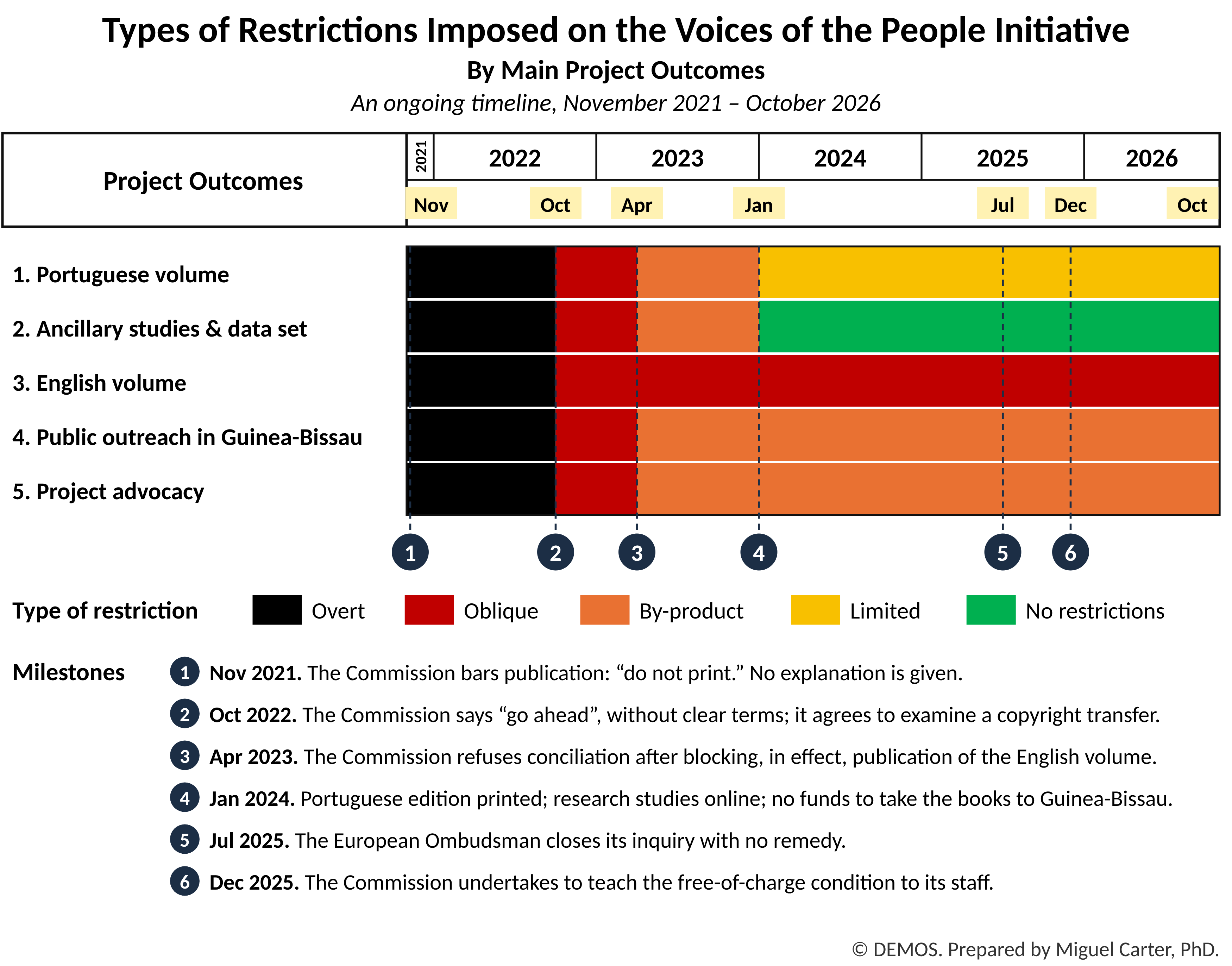
Censorship can be explicit or veiled. The veiled forms pass for something else: a delay, a procedure, a condition of contract, a side effect. They do no less harm; they are only harder to name. In this case, the restrictions took four forms, one after another. The explicit ban was lifted; the three veiled forms are still in force.
Overt
An explicit ban on any publication.
Oblique
Permission to publish, emptied by conditions that make publication impossible.
Limited
The Portuguese volume is out, but cut off from the usual channels of distribution.
By-product
The collateral damage: time, money, recognition and momentum lost, and work left undone.
The rights at stake are freedom of expression and academic freedom, protected by Articles 11 and 13 of the EU Charter of Fundamental Rights. They belong to the scholars who did the work — and to the citizens of Guinea-Bissau, to whom the study was meant to give a public voice.
The price of a relationship
On 26 November 2021, the EEAS Africa Director, Rita Laranjinha, met President Umaro Sissoco Embaló in private, in Bissau. Three days later, the order not to print arrived.
The relationship was cultivated in other ways. In August 2022 — six weeks after publication was declared “strictly prohibited” — President Embaló decorated the EU Ambassador, Sónia Neto. In May 2025, he decorated Ms Laranjinha.


All the while, Guinea-Bissau was sliding into autocratic rule. Few countries have fallen faster. International IDEA, the Stockholm-based intergovernmental body that assesses democracies, counts it among the five with the world’s severest declines in representation since 2020. The markers were plain. In December 2023, President Embaló dissolved the National Assembly. The Supreme Court was brought under presidential control. In August 2025, foreign news outlets were expelled. The main opposition party and its candidate were barred from the 2025 elections.
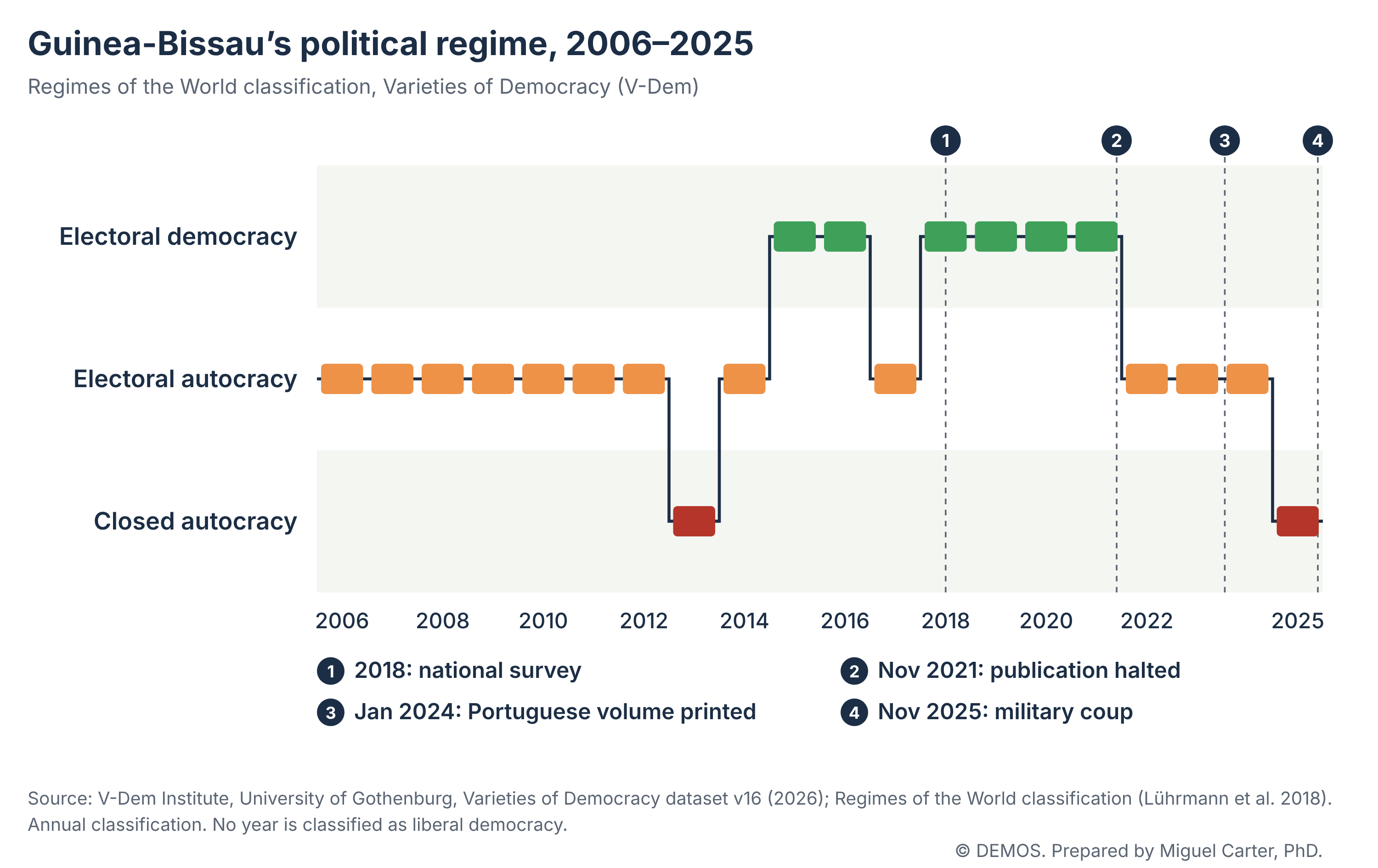
In 2022, the year after publication was halted, Varieties of Democracy (V-Dem), a global academic consortium that tracks political regimes, classified Guinea-Bissau as an electoral autocracy. After the coup of November 2025, it became a closed autocracy.
Transparency International places Guinea-Bissau among the 22 countries and territories perceived as most corrupt, out of 182. A flourishing drug trade, run under the protection of the political-military elite, compounds that corruption and fuels the country’s chronic instability. A UN estimate puts the cocaine transit through the country at more than two tonnes a month, bound for Europe; the revenues rival the entire state budget. Since 2020, the trade has boomed once again. In September 2024, a single plane landing in Bissau carried 2.63 tonnes.
Umaro Sissoco Embaló presided over all this. This is the leader that senior EU officials chose to cultivate personally. And this was the context in which EU officials censored the Voices of the People study — to protect, in their words, the EU’s “relations with Guinea-Bissau.”
What harms democracy abroad harms democracy at home
On 26 November 2025, a day before the presidential results were due, the military seized power and halted their announcement. By all appearances, President Embaló had lost. The coup deepened Guinea-Bissau’s autocratic slide.
Signals matter on such a slide. When the EU suppressed a study of citizens’ views to protect a relationship with an autocratizing president, it told civil society in Guinea-Bissau that critical research was not safe, even when the EU had helped pay for it. It raised doubts about the EU’s commitment to democracy and human rights. In doing so, it lowered the cost of political repression.
How small signals lower the cost of political repression
Guinea-Bissau, 2021–2025
- Nov 2021Publication of an EU-funded study of citizens’ views is halted in Guinea-Bissau, without explanation.
- 2022–2025Other signals follow: Guinea-Bissau’s autocratic president decorates the EU Ambassador (Aug 2022) and the EEAS Africa Director (May 2025).
- Civil society reads the signal: critical research is not safe, even when the EU funds it. Caution spreads.
- Doubts grow about the EU’s commitment to democracy and human rights.
- The cost of political repression diminishes.
- 2023–2025The autocratic slide advances: parliament dissolved (Dec 2023), courts subordinated, foreign press expelled (Aug 2025), the main opposition barred from the 2025 elections.
- 26 Nov 2025The military seizes power and blocks the announcement of the election results — by all appearances, adverse to the sitting president.
A censored book does not produce a coup. But in an autocratizing setting, signals like these lower the cost of repression. They enable the autocratic slide, rather than brake it.
What is tolerated abroad does not stay abroad. The practice applied to this study, left unchallenged by the European Ombudsman, is now an established norm, taught inside the EU’s own institutions.
Earlier documents
In January 2024, DEMOS set out the case in an Open Letter to the EU. It remains online, as written.
WEBJanuary 2024